
When we talk about the History of Assam Tea, we usually return to the same familiar names and moments, primarily the Singphos, Robert Bruce, Chabua, and Maniram Dewan, etc. But there is more to the Assam Tea story than that which catches the eye.
As every other day, I, being a diehard nerd about Assam tea history, was going through the blog called Koi-Hai.com when I found another thread that felt too unusual to ignore. It was not about a tea bush, a factory method, or even a famous estate. It was about a regiment that was created to protect the Assam tea gardens.

Image Courtesy: Koi-Hai.com
That regiment was the Assam Valley Light Horse. It was raised in Assam in 1891, had its headquarters at Dibrugarh, and was recruited from the European community of the region, mostly tea planters. In other words, many of the men supervising tea gardens in colonial Assam were also part of a mounted volunteer military unit.
From Mounted Rifles to Light Horse
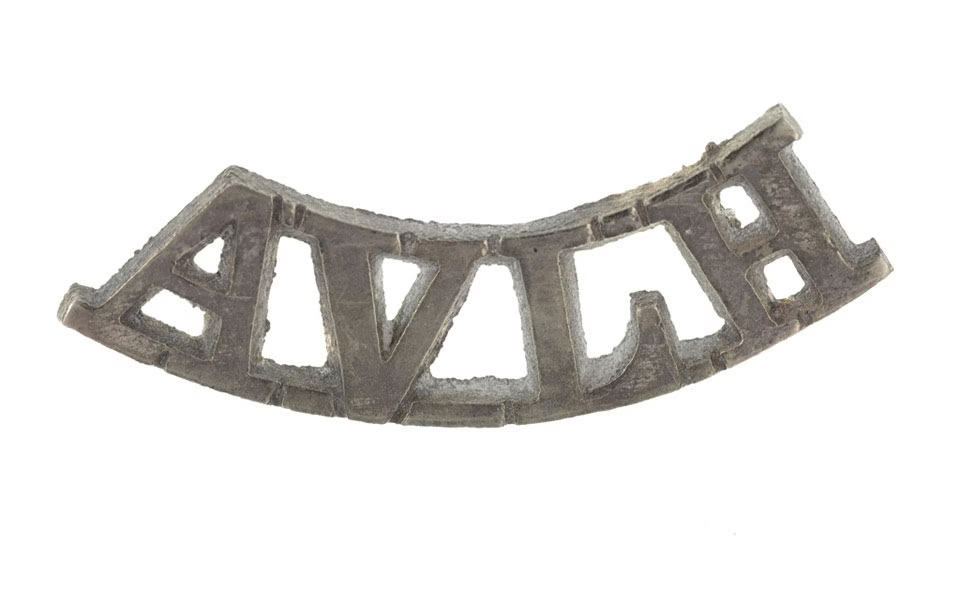
The story begins not with the AVLH name, but with an older one. The regiment first existed as the Assam Valley Mounted Rifles, and the National Army Museum in London still preserves a shoulder title for that earlier phase, dated 1891 to 1896. On 25 September 1896, the unit was renamed the Assam Valley Light Horse, and that later title too survives in the museum collection, covering the years 1896 to 1947, when it was formally disbanded.
I find this detail especially striking because it makes the story feel real in a very direct way. We are not dealing only with scattered anecdotes here. We have actual surviving insignia that mark the change from one regiment name to another.
A Tea Garden Regiment
What makes the AVLH so interesting for a tea blog is not simply that it was a regiment. It is that it was, in large part, a tea planter regiment. Online reference sources are consistent on this point: the membership came mainly from the tea planting world of Assam.
That single fact changes how one looks at colonial tea gardens. The planter in a bungalow was not only a manager or assistant looking after sections, labour, and manufacture. In many cases, he also belonged to a formal auxiliary military structure that sat alongside plantation life. The AVLH later formed part of the Indian Volunteer Force, then the Indian Defence Force, and finally the Auxiliary Force (India), which shows that it was not an informal club but a recognised military formation within the colonial system.
More Than a Name in an Archive
One reason the AVLH deserves more attention is that it appears across several different kinds of records. General reference sources identify its formation, composition, and later status within the colonial military structure. Museum holdings preserve its insignia. Military collectables and badge records also repeat the same broad fact that the unit was based in Assam and that the majority of its members were tea planters from the Assam Valley.
Then there are the named individuals who connect the regiment back to tea. One of the clearest examples is Lt. Col. Dugald Lumsden, whom The Spectator described in 1903 as a man who had been a tea planter in Assam for twenty years. His name matters because it gives us a bridge between the tea world of Assam and the wider imperial military record.
How Planters Joined
Every young British tea planter employed in Assam received a horse, a groom (syce), and free fodder as standard employment benefits. This perk meant every recruit was already a trained rider, fully equipped, and living near the estate’s polo grounds. These polo grounds essentially doubled as military parade grounds, folding cavalry drills seamlessly into weekend socialising.
Their Operations, in Brief
If we focus only on battlefields, this becomes a military history essay, which isn’t the point. Still, their operational record shows how the colonial administration used this tea planter regiment both locally and across the British Empire.
Here is a factual look at where these volunteers operated:
- A Domestic Emergency in Jorhat: The administration deployed the AVLH locally. When a local armed police battalion in Jorhat threatened mutiny, the Deputy Commissioner called out the AVLH. The tea planters rapidly mobilised, surrounded the police barracks, and disarmed the entire battalion without firing a single shot.
- The Northeast Frontier (1911–12): The British military deployed a small AVLH detachment, one officer, 12 men, and a Maxim gun, during the Abor Expedition. This regional campaign took place in the frontier hills just north of the Brahmaputra Valley (present-day Arunachal Pradesh). The official London Gazette still records that an AVLH captain, J.R. Hutchison, took a serious arrow wound there.
- The Boer War Connection (1899–1902): Dugald Lumsden, a twenty-year Assam tea planter, raised a volunteer cavalry unit called Lumsden’s Horse to fight in South Africa. The full published history of that corps is available today on Project Gutenberg.
- The Assam-Burma Border Evacuation (1942): While not deployed as a complete unit during WWII, the regiment’s members played a massive regional role. In 1942, former AVLH commanding officer Col. A.H. Pilcher raised a labour force of 82,000 men from Assam’s tea plantations to build an evacuation road for refugees fleeing Burma. In 1943, the British House of Commons formally acknowledged that the Indian Tea Association and local planters had supplied food and organised help for these evacuees, noting that several planters died in the effort.
Why This Story Matters
We often imagine tea history through leaf, land, labour, and trade. The AVLH adds another layer: institution. It tells us that the colonial tea garden was not only an economic unit but also part of a social and political order that could produce its own auxiliary regiment, preserve its own insignia, and leave behind a paper trail stretching from Assam to London.
That is what makes the Assam Valley Light Horse such an arresting subject for Assam tea history. It is not just a war story. It is a tea garden story hiding inside military records.
Surviving Assam Valley Relics
While the regiment officially disbanded in 1947, you can still find physical proof of its existence scattered across the globe today.
- Original Badges in London:

If you want hard proof that this regiment existed, the National Army Museum in London preserves the original silver shoulder badges for both the Assam Valley Mounted Rifles and the Assam Valley Light Horse. Anyone can look up their exact accession records (such as item 2013-10-20-83-90) right now in the museum’s online catalogue.
Image Credit: National Army Museum, London (Accession Number: 2013-10-20-83-90)
- The 1907-08 Silver Shooting Medals:

Beyond museum pieces in the UK, physical medals awarded by the regiment still circulate in Indian antique and auction circles. In recent years, a solid silver medal awarded by the Assam Valley Light Horse for the “1907-08 Best Shooting Squadron” (featuring crossed rifles and the regiment’s name) surfaced in an Indian numismatic auction. These medals prove the planters actively competed against each other in interestate marksmanship contests.
Image Source: Marudhar Arts Auction Archive.
- A Rescued Wastebasket Letter: In 1988, a quick-thinking individual rescued a two-page document straight from a superintendent’s wastepaper basket at the Makum Tea Company, creating one of Assam’s most incredible artefact stories. The Commanding Officer of the Assam Valley Light Horse wrote this original letter to list the tea planter officers from various Assam estates who joined the regular army and died during the fall of Singapore in WWII. Decades later, this fragile piece of paper helped a local woman trace her British tea planter father’s war record.
Interesting Facts & Locations
The history of the Assam Valley Light Horse is deeply tied to the geography of the Brahmaputra Valley, though some of those locations are now lost to time.
- The Jorhat Gymkhana Connection: If you visit the historic Jorhat Gymkhana Club today, you are standing on the exact grounds where the regiment gathered. During the colonial era, the organisers deliberately scheduled the famous Jorhat Race Week to coincide with the AVLH’s annual military drills, perfectly blending tea estate socialising with cavalry musters.
- A Submerged Headquarters: Throughout its existence, the regiment maintained its official headquarters on the elegant banks of the Dibru River in Dibrugarh, near the old Planters Club, the polo grounds, and the District Commissioner’s bungalow. Sadly, you cannot visit it today. The changing course of the Brahmaputra River swallowed the building, along with much of colonial Dibrugarh’s riverfront heritage, following the great 1950 earthquake.
- A Digitised History Book: You don’t have to visit a dusty archive to read about them. Historians fully digitised the complete 1903 book, The History of Lumsden’s Horse, which details how twenty-year Assam tea planter Dugald Lumsden led a volunteer cavalry of planters to fight in South Africa. You can read the entire account for free right now on Project Gutenberg.
Beyond the Tea Cup: A Closure Thought
The story of the Assam Valley Light Horse reminds us that the history of our tea gardens runs much deeper than the roots of the Camellia sinensis bushes. It shows us that the colonial tea estates of Assam were not just agricultural hubs, but deeply complex institutions tied to global events, regional conflicts, and a highly organised social order. The next time you take a sip of strong Assam black tea or walk past the misty lawns of an old planter’s bungalow, take a moment to look beyond the brew. The soil of those estates hides the forgotten stories of people who balanced tea production with cavalry drills, leaving behind a legacy that now exists only in quiet museums, rescued letters, and beneath the shifting waters of the Brahmaputra.
Have you ever come across any old relics, stories, or local legends about the Assam Valley Light Horse near your estate? Let me know in the comments below. I would love to keep digging into this forgotten chapter of Assam tea history!
Sources & References
- National Army Museum, London: Online Collection Archive. Shoulder titles of the Assam Valley Mounted Rifles (Accession: 2013-10-20-83-89) and Assam Valley Light Horse (Accession: 2013-10-20-83-90).
- Project Gutenberg: Pearse, Henry H.S. (1903). The History of Lumsden’s Horse. A complete digitised record of the volunteer cavalry raised from the Indian tea planter community for the Boer War.
- Families in British India Society (FIBIS): Historical archives and colonial military records about the Assam Valley Light Horse and their deployments.
- UK Parliament Hansard Archives: House of Commons Debate, 21 October 1943. Official records acknowledging the Indian Tea Association and local Assam planters for their role in the 1942 Burma evacuation.
- Koi-Hai Colonial Archive: Preserved oral histories, letters, and records of British tea planters in Assam, including the Dibrugarh & District Planters Club and the Jorhat Gymkhana.
- The Spectator Archive: Lumsden’s Horse (Published 3 October 1903). Historical press record confirming Dugald Lumsden’s twenty-year tenure as an Assam tea planter.
- South African Military History Journal: Vol. 18 No. 1. Lumsden’s Horse: The action at Os Spruit, 30 April 1900, documenting the unit’s engagement and casualties during the Boer War.

Leave a Reply