
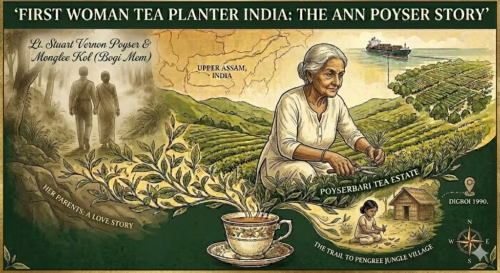
What’s unique about the name Ann Poyser? Ever heard of it? Well, in the history of India, she stands alone as the first woman tea planter India has ever seen. While names are usually etched in brass for colonial ‘Sahibs,’ Ann’s story is etched into the red soil of Pengree, marking a defiant shift in the industry’s heritage.
A Love Story Like a Movie: The Legend of “Bogi Mem”
In Assam, there’s a famous film called Chameli Memsaab about a forbidden love story between a British planter and a local labourer. Ann’s life is essentially the true-life inspiration for such tales.
Her father was Lieutenant Stuart Vernon Poyser, a British soldier and planter who came to Assam in 1932. He worked at the Badlabeta and Pengree tea gardens. There, he fell in love with Monglee Kol, a local Adivasi woman known as ‘Bogi Mem’. Their marriage was a quiet defiance of the strict social codes of the 1930s.
Tragedy struck early. In 1942, during the height of World War II, Stuart died in Singapore at just 30 years old. Ann was only a toddler. She grew up in a jungle village, navigating a world where she was an Anglo-Indian girl without a father, yet with tea literally flowing through her veins.
From Paperwork to the Plantations: Becoming the First Woman Tea Planter in India
For decades, Ann lived a quiet life. She worked as an adviser doing paperwork at the Namdang Tea Estate in Margherita. While the job was comfortable and ‘safe,’ the industry expected women to remain in clerical roles.
But in 1989, everything changed. Consequently, Ann took voluntary retirement and decided to honour her roots in the most literal way possible: by putting her hands in the soil.
With 50 bighas (roughly 16 acres) of land gifted to her by her mother, Monglee, Ann decided to start her own nursery. She famously admitted that, despite her heritage, she knew nothing about the science of planting. In a beautiful reversal of roles, she spent her days with the labourers. She learned the art of pruning, manuring, and nurturing tea bushes directly from workers who had spent their lives in the fields.
The Rise of Poyserbari: Success of the First Woman Tea Planter India
In 1990, she established the Poyserbari Tea Estate near Digboi. But it was not easy for her. Furthermore, she didn’t have a corporate backer or a massive inheritance; she had grit. Today, Poyserbari is celebrated as one of the cleanest and best-maintained gardens in the region.
- The Scale: The estate now produces roughly 1.2 lakh kg of green leaves annually.
- The Standard: It is Trustea-certified, meeting the highest global standards for sustainable and ethical tea production.
- The Legacy: Her daughter, Anita Poyser, and grandson, Shayan, have taken the family legacy global, exporting the finest Assam tea to international markets.
While historic locations like Chabua mark the birthplace of the industry, Ann Poyser’s journey marks the birth of a new era for women in tea.
Experience the Taste of Authentic Assam
Ann Poyser’s journey is a testament to the power of returning to organic, sustainable roots. If you want to experience the same bold, handcrafted quality that defines heritage gardens like Poyserbari, I highly recommend exploring the organic collections from Assamica Agro.
From their handcrafted organic black tea to traditional blends, they bridge the gap between small-scale farmers and tea lovers worldwide.
A Living Legend
Her cousin, author David Mitchell, eventually documented Ann’s life in the book Tea, Love and War. It’s a saga of finding identity in the middle of a world war and a colonial industry.
Indeed, even in her 80s, Ann is a beacon for women in Assam. She is proof that while the British may have started the industry, it is the spirit of women like her that truly keeps it alive.
Sources & Further Reading:
- Tea, Love and War by David Mitchell: This is the primary biographical source for the Poyser family history, detailing Stuart Vernon Poyser’s letters and the family’s journey in Assam.
- The Telegraph India: An essential interview where Ann discusses her transition from retirement to becoming a tea planter and her challenges at Poyserbari.
- Commonwealth War Graves Commission: The official record for Lieutenant Stuart Vernon Poyser, confirming his service with the Royal Engineers and his death in Singapore in 1942.
- The Koi-Hai Network: A historical archive for the tea planting community in Assam which contains numerous anecdotes and records regarding the Badlabeta and Namdang estates where Ann worked.
- Trustea Sustainable Tea Foundation: Verification of the ethical and sustainable certification standards that Poyserbari Tea Estate maintains today.
A small note: To support our work in sharing these heritage stories, some links in this post are affiliate links for Amazon & Assamica Agro. If you choose to buy through them, we may earn a small commission at no extra cost to you. We only recommend partners who respect the traditions of Assam tea.

Leave a Reply